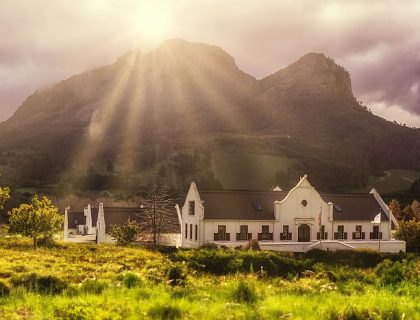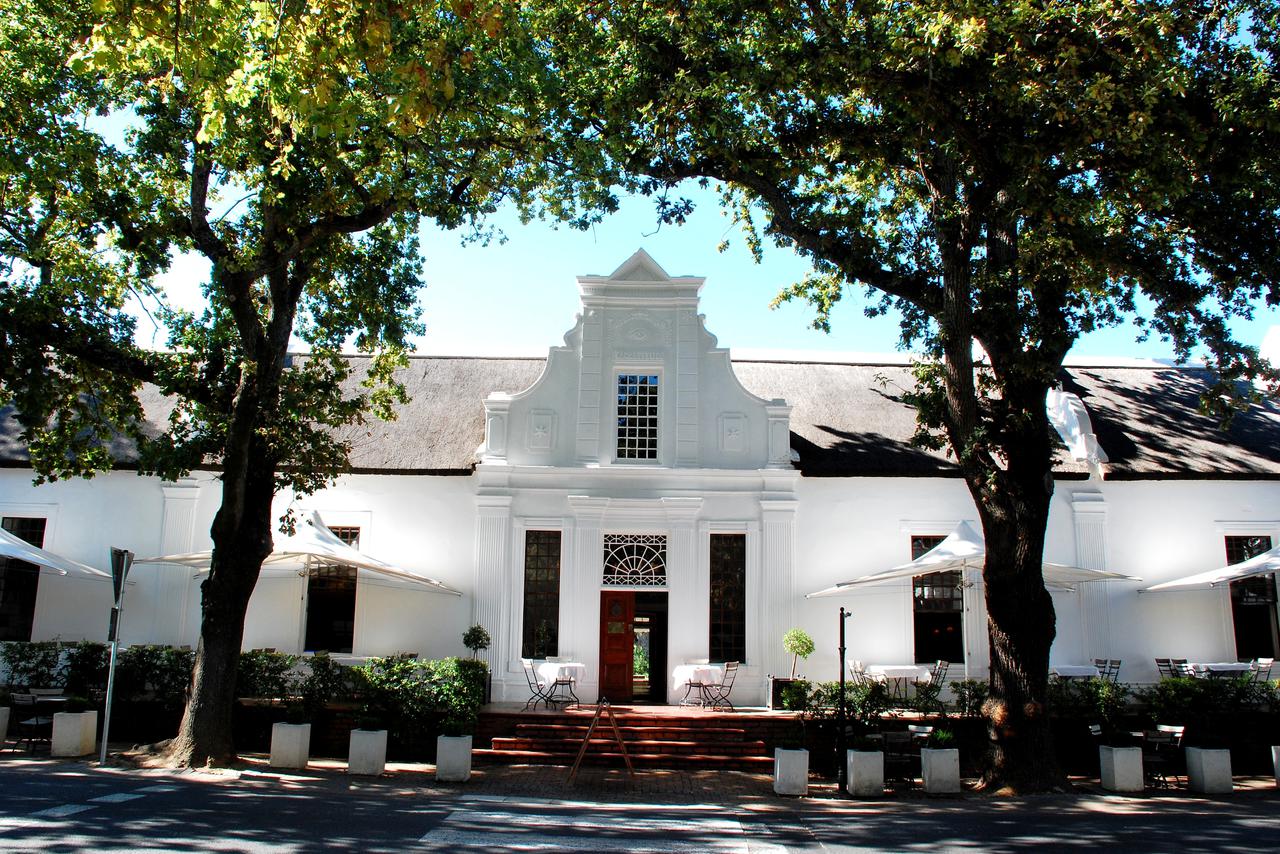
Ever wondered about the Cape Dutch Architecture of the Winelands?
Cape Dutch architecture is one of the Cape Winelands’ defining features: elegant whitewashed homesteads, graceful ‘’Dutch” gables, and thatched roofs set against vineyards and mountains. Found across Stellenbosch, Franschhoek, Paarl, Tulbagh, and beyond, these historic buildings tell the story of South Africa’s early settlers and remain central to the Wineland’s charm today.
When I first moved here over 33 years ago, I fell in love with this architectural style, and their love affair continues, especially when updated in an interesting contemporary way.
In this guide, we explore what defines Cape Dutch architecture, where to see the best examples, which wine estates are worth visiting, and where you can stay overnight in one of these beautifully restored homesteads.
What Is Cape Dutch Architecture?
One of the Cape Winelands’ quiet joys is stumbling upon a whitewashed homestead framed by vineyards, mountains, and oak trees. Perhaps its ornate gable casting a dramatic shadow in the late afternoon sun. This is Cape Dutch architecture, a style found nowhere else in the world.
Developed in the Cape during the late 17th and 18th centuries, Cape Dutch architecture grew from European roots. But it was shaped decisively by African conditions. Early Dutch settlers brought their architectural fashions from the Netherlands – such as ornate gables and steep roofs – and adapted them to the Cape climate. Thick whitewashed walls helped keep interiors cool in summer; small-paned shuttered windows controlled heat and light; and deep thatched roofs insulated homes against both summer sun and winter evenings.
Originally very practical, these homesteads became increasingly expressive as wealth grew. Gables evolved from simple firebreaks, to protect the thatch, into decorative statements, often displaying dates, initials, or family crests. Over time, Cape Dutch architecture became not just a building style, but a symbol of settled life in the Cape.
(Indeed the traditional thatched roof of the Cape Dutch homesteads has led to many being lost to fire over the centuries, including two in my own family.)
Cape Dutch Homesteads
Defining Characteristics of Cape Dutch architecture in South Africa
While no two Cape Dutch homesteads are identical, most classic examples share a recognisable set of features:
- White-washed
- Thatched roofs
- Usually decorative central gable (though older examples many be plainer.)
- Painted wooden shutters, traditionally in “heritage green” (doors as well)
- Expansive and tall multi-paned windows, much more than a classic Georgian house.
- Usually single storey, though many lofts have since been converted
- Many have a distinctive H shape or T shaped layout. (Usually they start as a T and then additional rooms are added to make an H-shape)
- Many have attractive outbuildings built in the same style such as a Jongmanshuis (Young man’s house, for the heir of the estate).
- Low white-washed walls surround the gardens and courtyards
As families prospered, homesteads expanded. A simple rectangular house often grew into a T-shape with rooms added to the back to form the spine of a T. If their wealth continued, wings were added to the bottom of the T to make a (sideways) H-shape. Unlike English manor houses, the front door is usually in the centre of the front façade, rather than set between projecting wings.
In addition to their attractive central gables, the charm of a Cape Dutch homestead also lies in the surrounding outbuildings. These were usually designed in a simpler, but similar, style. The oldest son would have a “young mans’ house” (Jongmans Huis) set up for him if he took a wife whilst his parents were still alive.
Stables, servant quarters, wine cellars, and laundries were built in a simpler but harmonious style: thatched, white-washed with small-paned windows edged with green, creating a balanced architectural ensemble. Low whitewashed walls would contain the homestead away from farm animals or crops.


Where to See the Best Cape Dutch Architecture in South Africa
While examples exist across the Western and Eastern Cape, a handful of towns stand out for their concentration and preservation of Cape Dutch buildings.
Stellenbosch, Tulbagh, Swellendam and Paarl have plenty of streets of Cape Dutch architecture. But you can find streets of Cape Dutch houses in other old towns such as Clanwilliam in the Cederberg or Graaff Reinet in the Eastern Cape.
Stellenbosch
Founded in 1679, Stellenbosch remains the heart of Cape Dutch architecture. Walking its oak-lined streets reveals a chronological spread of styles, from early homesteads to later, more ornate interpretations. A walk around Stellenbosch shows off the many styles of Cape Dutch architecture through the years.
A highlight is the Stellenbosch Village Museum, where four historic houses illustrate how settler homes evolved from the late 17th to the 19th century. It’s one of the best introductions to Cape Dutch architecture anywhere in the country.
Useful Links:
Bites & Sites foodie walking tour

Paarl, Tulbagh, Swellendam & Graaff-Reinet
Paarl’s main street is also lined with Cape Dutch houses, but surrounded by a larger town. So the small town of Tulbagh may be a more attractive option. Tulbagh’s Church Street is often cited as one of the finest surviving streetscapes of Cape Dutch and Cape Victorian buildings.
Swellendam offers elegant examples set against the Langeberg Mountains, while Graaff-Reinet, in the Eastern Cape, preserves a remarkable concentration of historic homes, including the impressive Drostdy complex.

Let’s Start Planning your historical Winelands visit…
Tell us what you have in mind and we'll craft the perfect stay in an historic Cape Dutch homestead
Contact Us NowCape Dutch Wine Estates Worth Visiting
Many of the Winelands’ most celebrated wine estates grew around historic homesteads, blending architectural heritage with modern wine-making. Some, such as Boschendal, Babylonstoren and Vergelegen, are open to visitors.
Vergelegen Wine Estate
Once the home of the Cape Governor, Simon van der Stel, Vergelegen is an elegant, tranquil wine estate in Somerset West. It combines historical gravitas with beautifully maintained gardens. Visitors can tour parts of the original Cape homestead, wander through manicured gardens, picnic under centuries-old camphor trees. We also recommend a visit to their state of the art contemporary wine cellar as well as choosing one of the wine tasting options.
INSIDER TIP: You may like to combine a visit with the nearby wine and olive estates of Lourensford and Morgenster.
Cape Dutch Homesteads – Vergelegen in Somerset West
Boschendal Wine Estate
Built in 1812, Boschendal’s current manor house is one of the most visually striking examples of Cape Dutch architecture. While the interior is no longer on show, the exterior, outbuildings, glorious new gardens, farm shop, and restaurant make this a rewarding stop between Stellenbosch and Franschhoek.
You can also choose to stay at Boschendal; either in the Werf cottages close by or in more contemporary farmstyle cottages.
INSIDER TIP: Book a gourmet picnic to eat in their oak-laden grounds.


Babylonstoren
While the manor house itself is reserved for guests taking it on an exclusive use basis, Babylonstoren remains a must-visit for its Villandry-style gardens, tasting rooms, Babel or Conservatory restaurants, and exceptional farm experience. All framed by classic Cape Dutch outbuildings.
Again you can stay at Babylonstoren with a choice of fabulous contemporary accommodation in their Cape Dutch outbuildings
INSIDER TIP: For retail therapy, there are not one but two very good farm shops, one focused more on produce and one focused more on home décor items
Other Cape Dutch Wine Estates to Visit
(Outside views only)
- L’Ormarins, Franschhoek – the gracious outbuildings house the introduction to the Franschhoek Motor Musuem and the Wine-tasting rooms
- Blaauwklippen Wine Estate, between Stellenbosch & Somerset West – newly reopened wine estate and restaurant
- Spier Hotel, near Stellenbosch – hotel, restaurant, spa with plenty on offer in the grounds
- Rustenberg, near Stellenbosch – superb garden open on selected days
Check out the top Restaurants in the Cape Winelands
Check out the top Foodie destinations in the Winelands – both fine dining and great casual options Get our Free Restaurant Guide hereStaying in a Cape Dutch Homestead
One of the great pleasures of the Winelands is that many historic homesteads now operate as boutique hotels, allowing you to sleep beneath thatch and wake to mountain views.
Prime Winelands Stays are:
- Lanzerac Hotel & Spa, Stellenbosch
- Babylonstoren Hotel & Wine Estate, between Paarl & Franschhoek
- Boschendal Wine Estate, between Stellenbosch and Franschhoek
- Spier Hotel & Spa – between Stellenbosch & Cape Town
- Hazendal Hotel & Spa, north of Stellenbosch
- Grande Roche Hotel & Spa, Paarl
- La Cotte Farm Hotel, Franschhoek
- Hawksmoor House, northern Winelands
In the Constantia Area of Cape Town
- Alphen Hotel, Constantia
- Steenberg Hotel & Spa, Constantia
- Cellars-Hohenort Hotel, Constantia
Elsewhere
- Drostdy Hotel, Graaff Reinet, Eastern Cape

Lanzerac Hotel

Babylonstoren

Boschendal Wine Estate
How we can include Cape Dutch Architecture in our Itineraries?
At Cedarberg Africa, we often weave Cape Dutch architecture into broader Winelands itineraries: pairing heritage stays with wine tastings, garden visits, and scenic drives. Many clients enjoy combining Stellenbosch and Franschhoek with quieter corners such as Tulbagh in the northern Winelands
Some of our sample itineraries & tours which include Cape Dutch hotels:
- Southern Africa Culture & Wildlife – privately guided
- Gourmet & Boutique South Africa – privately guided
- Mellow Cape – self drive
- Cape Golf (or Golf & Game) – self drive (or privately guided on request)
- Romantic South Africa – self drive
- Bites & Sights Foodie walking tour – excursion
Note: All of our itineraries are tailor-made, so you can also just ask to include one or two Cape Dutch hotels in your itinerary
Cape Dutch Outbuildings
Frequently Asked Questions on Cape Dutch Architecture
What makes Cape Dutch architecture unique?
Its blend of European design with African climate adaptation: particularly the gables, thatched roofs, and whitewashed walls make it distinctive to the Cape.
Can you stay overnight in historic Cape Dutch buildings?
Certainly. Many homesteads have been restored as boutique hotels, particularly around Stellenbosch, Franschhoek, Paarl, and Constantia (Cape Town).
Which Winelands town is best for Cape Dutch architecture?
Stellenbosch offers the greatest concentration, but Tulbagh and Graaff-Reinet are also outstanding.
Planning a Winelands Trip with Heritage at Its Heart
If you are interested in staying in a Cape Dutch homestead, or learning more whilst on your trip, tell us and we will design an itinerary with this in mind.
- Choose whether you prefer towns, wine estates, or countryside stays
- We’ll suggest one or two heritage hotels to anchor the experience
- We’ll refine the routing, touring suggestions and hotels

Let’s Start Planning your Winelands visit…
We’ll craft a Winelands itinerary that balances architecture, wine, landscapes, and the pleasures of travelling at an unhurried pace.
Chat to Us NowCape Dutch Architecture was written by Kate of South Africa safari specialists, Cedarberg Africa
Cedarberg Africa is an Africa safari specialist focusing on Southern and East Africa. We design tailor-made itineraries which are created around YOUR interests.
Kate co-founded Cedarberg Africa in 1995 with her sister Ginny and has lived in South Africa for over 30 years. She has explored the Cape Winelands extensively, from historic homesteads and wine estates to lesser-known heritage towns. With decades of experience designing tailor-made journeys, the team at Cedarberg Africa brings a deep appreciation of how architecture, landscape, and local culture combine to shape memorable travel experiences.