The vast Etosha salt pan, the shimmering dunes of Sossusvlei and the Namib Desert plus the contrasting of the Caprivi wetlands make Namibia an exhilarating safari destination. One led by spectacular landscapes, space and silence as much as wildlife.
A Namibia safari is an exhilarating and richly varied experience. One day you’re scanning the vast Etosha salt pan for elephant and lion; a few days later, watching first light ignite the towering dunes of Sossusvlei. From the stark beauty of the Namib Desert to the watery paradise of the Zambezi region, Namibia is defined by contrast, scale and space.
The name Namibia is often translated as “place of vast, arid plains” — an apt description for this strikingly beautiful country. Here, gemsbok, springbok and kudu roam freely across open landscapes, while desert-adapted elephant and rhino thrive in conditions that seem, at first glance, inhospitable.
But Namibia is not only about wildlife: it is also about sculpted mountains, mood and light, and the powerful sense of perspective that comes from travelling through such immense terrain.
Namibia – How to Get Around
Namibia is a large country, and we recommend at least two weeks – and ideally three -to experience it at an enjoyable pace.
One of the first decisions is how you wish to travel. It’s easy to take self-drive safari in Namibia, but private guided journeys, small-group tours and fly-in safaris in Namibia are all excellent options as well, depending on your time, confidence and budget.
Many of our clients choose to mix it up; perhaps flying between remote regions and driving to others. Talk to us about your preferences!
Our private guides are especially popular for families or groups of four or more, while truly remote areas such as the Skeleton Coast are best accessed by light aircraft.
(A few lodges can even be combined using scheduled transfers. See our Namibia to Go sample trip
Talk to us about what suits your travel style — Namibia is wonderfully flexible.
Where to Go in Namibia
Etosha National Park - A classic African safari played out around vast salt pans and waterholes, offering exceptional game-viewing in a stark, open setting.
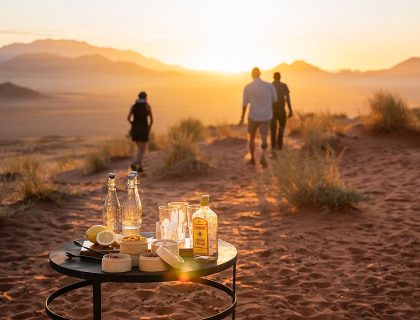
Sossusvlei & the Namib Desert - Towering red dunes, sculpted by wind and light, create one of the most iconic and photogenic landscapes in Africa.
Damaraland - A rugged, geological wonderland where desert-adapted elephant and rhino move through ancient valleys and dramatic rock formations.
Skeleton Coast - Remote, atmospheric and hauntingly beautiful: a wild stretch of fog-shrouded coastline where desert meets Atlantic. Inland is the Kaokoveld, home to Himba communities and vast, untamed landscapes that feel truly untouched.
Swakopmund & the Central Coast - A cool coastal interlude of German heritage, adventure activities and Atlantic air making it the perfect contrast to the desert interior.
Southern Namibia - A rewarding journey of red sands, ghost towns and geological drama, from the Kalahari to the immense Fish River Canyon.
Caprivi Strip (Zambezi Region) - Lush, riverine and wildlife-rich, offering a completely different side of Namibia with boat safaris and classic big game.
Central Highlands& Windhoek - Rolling hills, conservation-led lodges and Namibia’s relaxed capital — an ideal starting or finishing point for any journey.
Selected Namibia Safari Holidays to Check out:
Have a look at our suggested safari trips as well as our independent unbiased reviews of lodges in Namibia.
Whether you dream of desert silence, classic safari or remote coastlines, Namibia rewards thoughtful planning. Speak to our Africa specialists to design a journey that reveals the country’s many layers — at your pace, and in your style.
Why We Love It
The sheer scale and drama of Sossusvlei’s dunes
Big game encounters in Etosha’s open landscapes
Tracking desert-adapted elephant and rhino in Damaraland
Floating silently over the Namib by hot air balloon
Enjoying the arid-adapted wildlife in the Kalahari Desert
Remarkable contrast from the Fish River Canyon to the Caprivi wetlands, or Kolmanskop ghost town to the rock art of Twyfelfontein
Possibly encountering Himba communities in the Kaokoveld and Skeleton Coast
Hot and mostly dry, but with regional differences. The Caprivi Strip (Zambezi region) is much greener and wetter with distinct summer rainfall. This is echoed - to a lesser degree - in the interior areas of the central Highlands and Etosha. Afternoons may see torrential downpours which can cause flash floods.
But as you travel west and south, the Coastal areas, Namib and Kalahari deserts remain arid. Wildlife is much more dispersed and harder to spot, so this isn’t the ideal season for a wildlife safari. But landscapes are lush and skies dramatic. And – if you can cope with high temperatures – it’s a very quiet time to visit, compared to later in the year.
Now the rains taper off, temperatures are pleasant and game-viewing improves as vegetation thins. But the landscape is still green and lush. There are fewer visitors than later in the dry season, with shoulder season pricing as well.
Day-time temperatures are very pleasant (25-26C on average, away from the coast). However in the desert, the night-time temperatures are very cold getting down to a chilly 5-6C by June.
These are the peak safari months, especially for Etosha and Damaraland. Wildlife congregates around the waterholes, days are clear, and nights can be cold. And game-viewing keeps on getting better and better. However it is also a very popular time to visit so you need to book well ahead to get accommodation, and don’t expect to have the place to yourselves.
We particularly recommend September as it’s slightly less busy, the nights are warmer and game-viewing is excellent.
Hot and dry conditions build before the rains arrive. Game-viewing is still strong in October, but November is unpredictable depending on when the rains come. This leads to a fairly dramatic change in game-viewing as the wildlife disperse across the plains.



 Sossusvlei & the Namib Desert